
East-west engagement rings and what changes when the stone turns
Same stone, same finger, a quarter turn. It changes how the ring sits on the hand, how the points are protected and which wedding band will sit beside it. Here is how to decide whether it is the right way around for you.
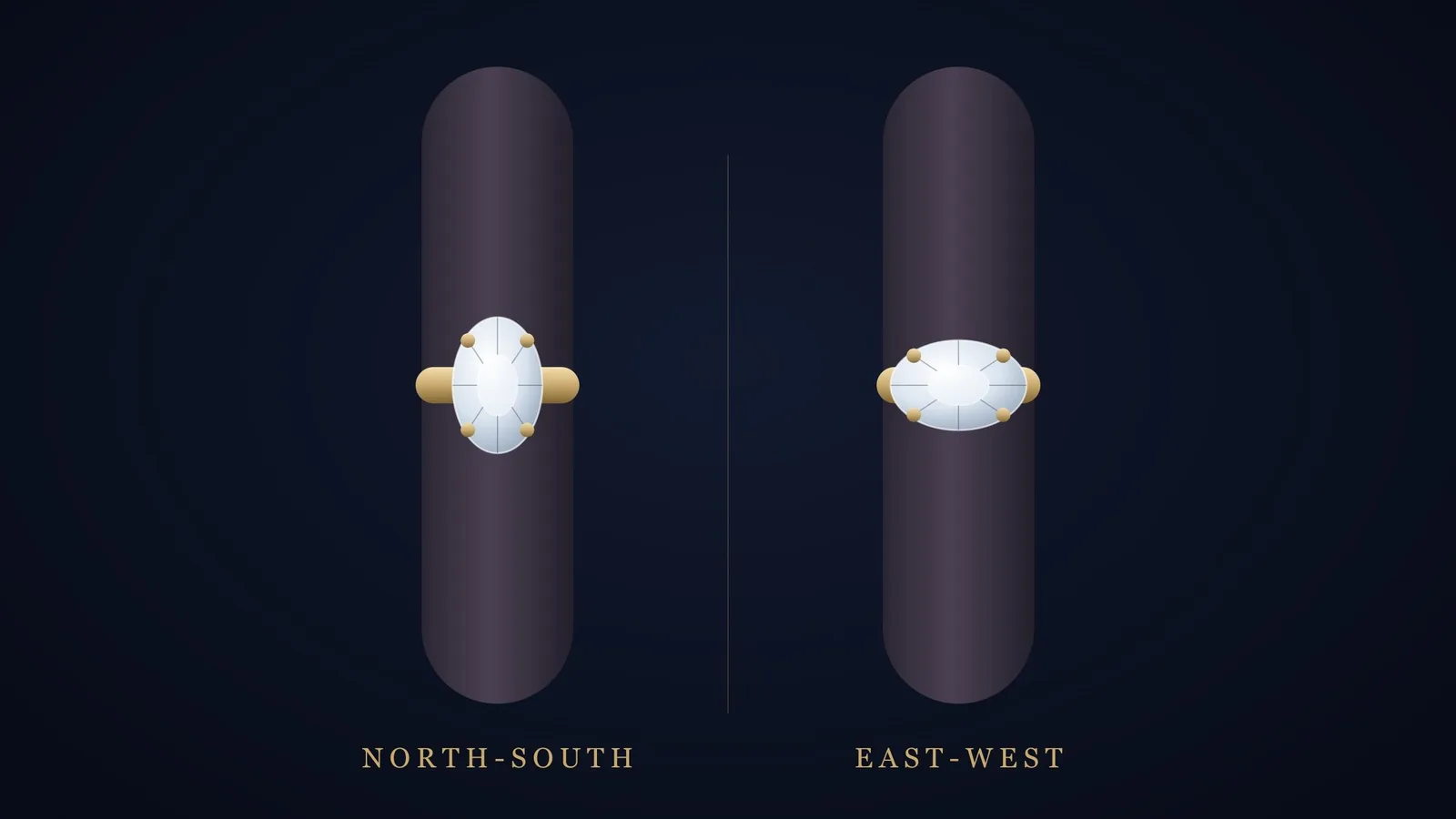
What east-west means
Most elongated diamonds are set north-south, with the long side of the stone pointing toward your fingertip. An east-west ring, also called a horizontal or sideways setting, turns that same stone a quarter turn so it lies across the finger instead. Nothing about the diamond changes. Everything about how it sits on the hand does.
It has been seen a great deal lately. Zendaya arrived at the Golden Globes in January 2025 wearing what Vogue described as a bezel-set east-west diamond. The shapes that suit it are more popular than ever. In The Knot's 2026 Real Weddings Study, ovals were chosen by 25% of couples, almost level with round at 26%.
None of this is new, though. Vogue's jewelry director has pointed out that sideways settings were popular in the Art Deco era and hard to find in modern cases until recently. The Victoria and Albert Museum holds an English ring from around 1800 whose diamonds were deliberately arranged in a broad horizontal design. Turning a stone is one of the simplest ways a jeweler has of making a familiar shape feel personal.
Bigger, smaller or just wider
Ask three jewelers whether an east-west stone looks bigger and you will hear three answers. Some say it looks larger and some say smaller. Others say it makes fingers look longer or wider. They are all describing the same thing from different angles.
Whether that reads as bigger depends on your hand. On a slender finger a sideways oval can look generous and modern. On a shorter, wider finger it can stretch almost to the edges, which some people love and others find heavy. No chart settles it. Holding the loose stone across your finger and then along it, in daylight, settles it quickly.
Which shapes turn well
Only a stone that is longer than it is wide can be east-west at all. A round or a square diamond looks identical either way, so the choice is really between the elongated shapes. Proportion matters more than usual, because a quarter turn exaggerates whatever the stone already does.
| Shape | Turned across the finger | Worth knowing |
|---|---|---|
| Oval | Soft and modern, the easiest place to start | GIA puts the traditional oval between 1.40 and 1.50. Longer ovals are more likely to show a dark bow-tie through the middle |
| Emerald | Clean and architectural, with an Art Deco feel | A step cut shows clarity more openly than a brilliant, so inclusions are easier to see |
| Elongated cushion | Rounded corners and a softer, vintage outline | Ask for the actual measurements. Cushions vary a great deal in how long they really are |
| Marquise | Dramatic, almost a bar of light | GIA gives 1.75 to 2.25. Both points sit at the sides of the finger, where hands brush against things |
| Pear | Asymmetric and unusual | GIA gives 1.50 to 1.75. You choose whether the point faces the thumb or the little finger |
If you are torn, an oval is the gentlest way in. If you want the ring to look unmistakably deliberate, an emerald cut turned sideways is about as clear a statement as a solitaire can make.
Points, prongs and everyday wear
Turning the stone moves its most exposed parts to the sides of your finger, which is where a hand meets door frames, coat sleeves and bag straps. A good east-west setting is built with that in mind from the start.
- Protect the points. On a marquise or a pear the tips are the thinnest part of the stone. Jewelers usually guard them with V-shaped prongs or a partial bezel rather than a single claw.
- Consider a bezel. A rim of metal around the whole stone, the look reported on Zendaya's ring, smooths the outline and leaves nothing to catch.
- Watch the length against your finger. A long stone across a narrow finger can reach toward the fingers on either side. A few millimeters less length can make a ring far more comfortable to live with.
- How the head is built and how the prongs are set decide security far more than which way the stone faces.
The wedding band, planned at the same time
This is the detail most worth planning early. A sideways stone often overhangs the band on both sides. A straight wedding band then touches the stone before it reaches the band of the engagement ring, which leaves a gap where the two never sit flush. The usual answers are a band contoured to curve around the stone, an open band or a setting raised just high enough for a straight band to slide underneath.
All three work. What does not work well is choosing the engagement ring first and hoping a band will fit it a year later. When both are drawn together the profile of the band can be shaped to the ring from the beginning, which is how couples end up with a pair that sits flush on the first day it is worn.
Deciding the direction at the desk
The orientation is a decision best made with the stone in front of you rather than in a photograph. At Astra Jewelers in Montclair the loose stones come out on the desk, natural and lab grown side by side. You can hold the one you like across your finger and along it before anything is drawn.
Once the direction is chosen the ring is designed around it. You see a 3D preview of the design and a printed model to try on the hand. The exact price is agreed before anything is cast. The wedding band is designed alongside it, so the two are made for each other.
East-west suits many hands and not every one. It is a choice worth making with the stone on your finger, which is easiest when the ring is being designed around it.
Common questions
What is an east-west engagement ring?
It is a ring with an elongated stone, such as an oval, emerald or marquise, set horizontally across the finger instead of pointing toward the fingertip. The stone is the same. Only its direction changes.
Does an east-west setting make the diamond look bigger?
The face of the diamond is the same size either way. Set east-west it covers more of the width of your finger and less of its length. On some hands that reads as larger and on others simply wider, which is why it is worth trying the loose stone both ways.
Which diamond shapes work best east-west?
Oval, emerald, elongated cushion, marquise and pear all work. A round or square stone looks the same either way. An oval is the gentlest choice and an emerald cut makes the boldest, most architectural statement.
Do east-west rings snag more?
They can if the points of the stone are left exposed at the sides of the finger. V-shaped prongs or a partial bezel on the points keep the outline smooth. So does a full bezel around the stone. How the setting is built matters more than which way the stone faces.
What wedding band goes with an east-west ring?
Usually a contoured band that curves around the stone, an open band or a straight band paired with a setting raised high enough for it to slide underneath. Designing the engagement ring and the band together is the surest way to get a pair that sits flush.
Can an east-west stone be reset north-south later?
Usually. The diamond itself does not change, so it can be reset in a new setting facing the other way. It is easier still to decide before the ring is made, by holding the loose stone both ways on your finger.
Where can I design an east-west engagement ring in Montclair?
Astra Jewelers is on the second floor at 250 Bellevue Ave, Montclair, NJ 07043. Every engagement ring is made to order, starting with the stone you choose. Visits are by appointment and you talk directly with Eddie or Stephanie.