
How to find her ring size without her knowing
Most of the tricks do not work. It matters less than you have been told, unless the ring you have picked is one of the two that cannot be resized at all.
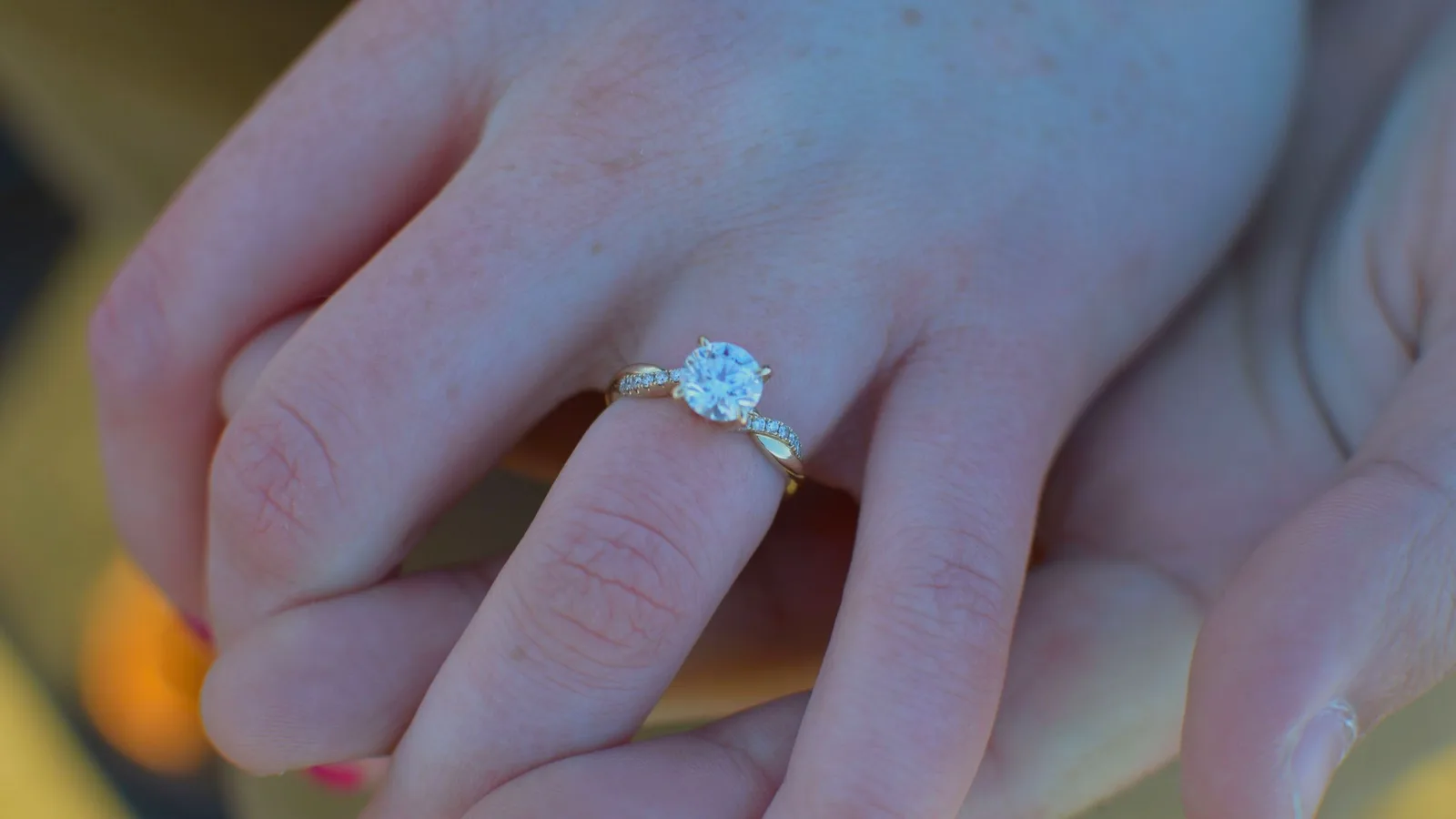
The number you are probably guessing at
Sizes 6 and 7 account for close to half of the women's rings sold in the United States and 6.5 is the most common single size. If you knew nothing at all and had to order this afternoon, 6.5 is the guess with the best odds behind it.
That is not permission to guess. It is the floor you are working up from and it changes the shape of the problem. You are not hunting for an unknown number somewhere between 3 and 13. You are trying to confirm or move off a number that is already likely, which is a much smaller job than the ten step articles suggest.
Which of the sizing tricks work
Every article on this subject lists six to ten methods as though they were equally good. They are not. Sorting them is more useful than adding to the pile.
- Borrow a ring she already wears on that finger. This is the only method that produces a real measurement rather than an estimate. It has to be the correct finger, because hands are not symmetrical and the ring she wears on her right hand will usually run larger.
- Take that borrowed ring to a jeweler instead of measuring it at home. It goes on a mandrel and the answer takes about two minutes. Doing it yourself with a ruler across the inside diameter is where the accuracy gets thrown away.
- Trace the inside of the ring on paper if you cannot keep it long enough to bring in. Better than nothing and worse than the ring itself, because you are now reading a pencil line whose thickness is part of the measurement.
- Ask her sister, her mother or the friend she shops with. This is the most reliable method on the list after borrowing a ring and the one people skip, usually because it feels like a bigger secrecy risk than it is. They often already know.
- String or a strip of paper wrapped around her finger while she sleeps does not work. String stretches under any tension at all. Paper does not sit flat. Neither one gets past the knuckle, which is the part that decides whether a ring goes on.
- A printable paper ring sizer is wrong by default. Almost every printer scales a page slightly to fit its margins. If the sheet has a calibration line, check it against a ruler before you trust anything the sizer tells you. If it does not have one, throw it away.
Why the setting matters more than the measurement
Here is the part the trick lists leave out entirely. Whether being one size off is a twenty minute correction or a ring that has to be built again is decided before you guess, by which ring you choose.
A jeweler resizes a ring by cutting the shank at the bottom, either removing a section or adding one, then soldering it closed and finishing the join. That works because the bottom of the band is plain metal doing nothing except being metal. The moment stones run down the shank, cutting and bending it stops being a small job and starts being a threat to whatever is set into it.
So the question worth asking in the showroom is not only whether you like the ring. It is how much room the ring gives you to be wrong.
- Plain or solitaire shank, stones only at the top. Two sizes in either direction is routine work. This is the forgiving choice and it is the one to lean toward if you are proposing with a size you are not sure of.
- Pavé running partway down the shank. Roughly half a size to a full size. Flexing the shank flexes the tiny beads holding each accent stone. Pushed past that they start to loosen.
- Channel set stones along the band. Tighter again. Bending the band changes the width of the channel and the stones sit inside that channel, so the thing you are altering is the thing holding them.
- Full eternity band, stones the whole way around. Cannot be resized. There is no plain section to cut, so the answer is a new band rather than an altered one.
- Tension setting, where the stone is held by the spring pressure of the band itself. Cannot be resized. Changing the band changes the pressure. That pressure is the only thing holding the diamond.
Two of those five are not repairs. They are new rings. If you have your heart set on a full eternity band or a tension set stone and you are still guessing at the size, you are carrying a risk the person buying a solitaire next to you simply is not carrying. That is worth knowing before you pay, not after.
The knuckle problem
A ring has to clear a knuckle that on most hands is wider than the base of the finger it ends up sitting on. That gap is why two people with the same finger measurement can need different sizes.
Someone with pronounced knuckles wears a ring that feels a little loose at the base. That is correct rather than a fault. It is also why a borrowed ring beats any measurement of the finger alone. The ring already got over the knuckle once, which is the only proof that matters. If the finished ring ends up loose at the base, sizing beads or a fitted insert solve it without changing the size at all. That is usually the cheaper fix.
Five things people get wrong
These come up at the counter constantly and four of the five cost money.
- I will just get it resized afterward. True for most rings and untrue for two of them, which is the whole point of the section above. It is also worth asking what a resize costs and how long the seller's own adjustment window runs, because that window is not open forever.
- Her other hand will do. The dominant hand usually measures larger, commonly by about half a size. Sizing a left hand engagement ring from a right hand ring tends to produce a ring that spins.
- I measured in the morning so it is accurate. Fingers move up to a full size with heat, time of day and salt. A reading taken cold, first thing, in January is the smallest number that finger will produce all year. Mid afternoon at normal room temperature is the honest one.
- Go large to be safe. This is the expensive mistake dressed as the cautious one. A ring that is slightly tight is uncomfortable for an evening. A ring that is loose turns so the stone sits under the finger and then comes off in a coat pocket. Loose is how rings are lost. Nothing fixes a ring that is already gone.
- The ring has to be the final ring on the day. It does not. Treating the proposal and the purchase as one event is what creates most of this anxiety in the first place.
The last one is the item on this list that saves people money rather than costing it.
If you genuinely have no idea
You have three honest options and none of them involves a piece of string. Order the likely size and plan the adjustment, which works cleanly on a plain shank and badly on the settings listed above. Propose with a simple band and choose the ring together afterward, which is increasingly common and removes the guess completely. Or bring in a ring she already wears and have it measured properly, which takes about as long as parking.
At Astra Jewelers we will measure a ring or a finger free and without a purchase, at 250 Bellevue Ave, 2nd Floor in Montclair. Resizing is coordinated through jewelers we trust and quoted after someone has looked at the piece rather than off a list, because what the shank is carrying changes the job. If you bring in a ring that turns out to be a style that cannot be resized, we will tell you that before you commit to it.
Common questions
What is the most common engagement ring size?
In the United States sizes 6 and 7 together account for close to half of women's rings and 6.5 is the most common single size. That makes 6.5 the best available guess if you have nothing else to go on, but treat it as a starting point rather than an answer. A borrowed ring measured on a jeweler's mandrel takes two minutes and replaces the guess with a real number.
How can I find out her ring size without her knowing?
Borrow a ring she already wears on the correct finger and bring it to a jeweler to be measured. That is the only method that produces a measurement rather than an estimate, because the ring has already proved it clears her knuckle. Asking her sister, her mother or the friend she shops with is the next most reliable route and people skip it more than they should. String around a sleeping finger and printable paper sizers are the two methods most likely to give you a confident wrong answer.
Can an engagement ring be resized after the proposal?
Most can and two common styles cannot. A plain or solitaire shank usually moves two sizes in either direction without difficulty. A pavé shank moves about half a size to a full size before the beads holding the accent stones are at risk. Channel set bands are tighter still because bending the band changes the width of the channel. A full eternity band has no plain section to cut and a tension set ring relies on the band's pressure to hold the stone, so both of those are remade rather than resized.
Is it better to guess too big or too small?
Too small, if you have to choose. A slightly tight ring is uncomfortable for an evening and then gets adjusted. A loose ring rotates so the stone sits under the finger and it comes off without being noticed, most often when a hand goes into a pocket or a glove. Sizing beads or a fitted insert will tighten a ring that is a little large, so there are fixes on that side too, but there is no fix for a ring that has already been lost.
Does finger size really change during the day?
Yes, by up to a full size. Heat, time of day and salt all push in the same direction, which is why a measurement taken cold and first thing reads smaller than the finger really is. Measure mid afternoon at normal room temperature. This is also why a ring that fits perfectly in a February fitting can feel tight in August without anything having changed about the ring.
Where can I get a ring measured or resized near Montclair, New Jersey?
Astra Jewelers at 250 Bellevue Ave, 2nd Floor, Montclair, NJ 07043 measures rings and fingers free and without a purchase, Monday to Friday, 10:00am to 6:00pm, Saturday until 5:00pm. Bring a ring she wears on the correct finger and it is measured on a mandrel while you wait. Resizing is coordinated through jewelers we trust and quoted after the piece has been looked at, because what the shank is carrying changes the work. If a ring is a style that cannot be resized we will say so before anything is agreed.