
When the band of a ring wears thin
A ring worn every day loses metal from the bottom of the band, slowly and out of sight. Here is how to check yours, how thin is too thin and what a jeweler does about it before it cracks.
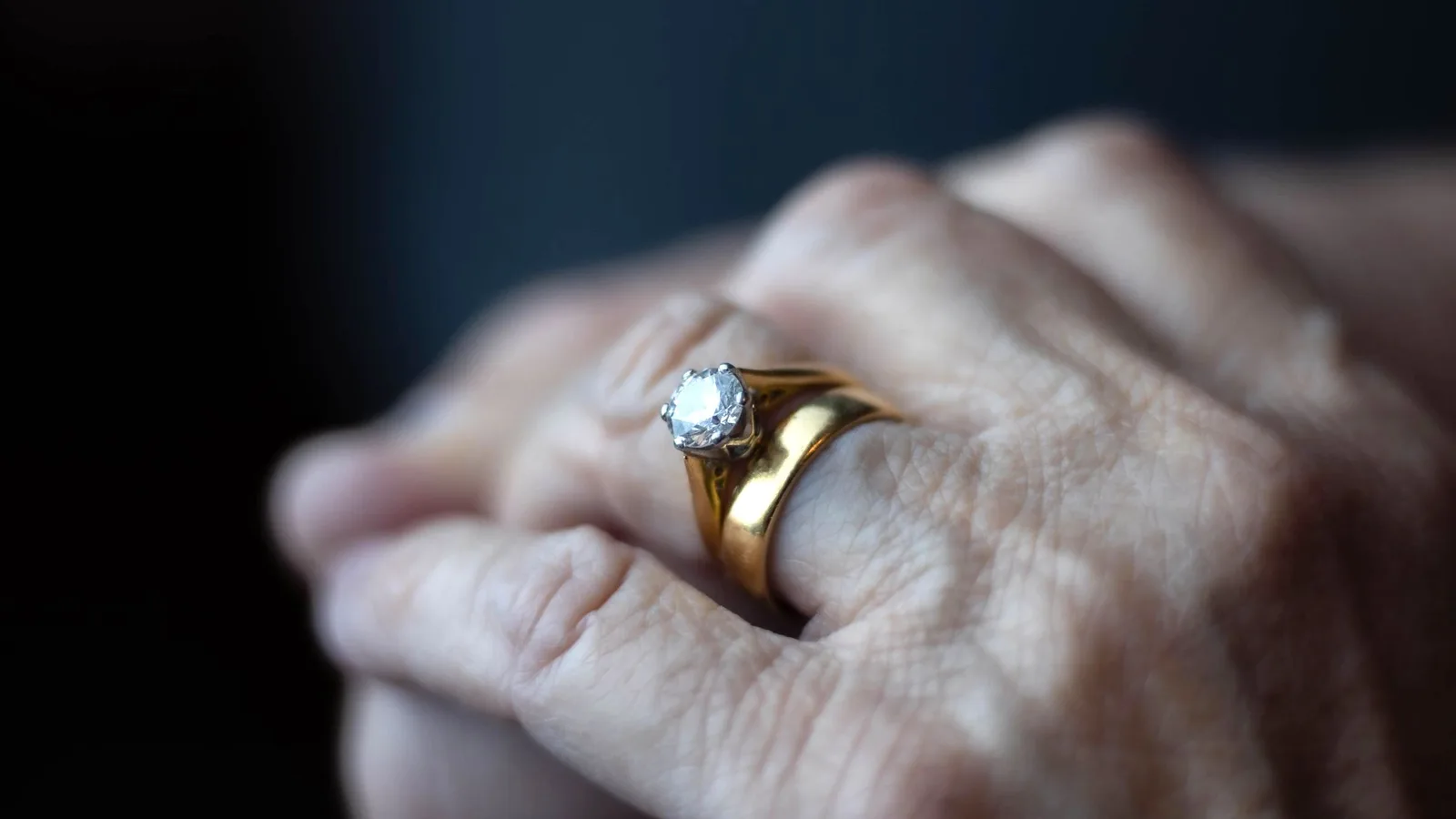
Why the bottom of the band goes first
The top of a ring is what you look at. The bottom is what does the work. It sits against your palm, so it is the part that meets the steering wheel, the shopping bag handle, the desk and the gym bar many times a day. Each contact takes away a trace of metal. Over ten or twenty years those traces add up to a band that is visibly thinner underneath than it is beside the stone.
A second ring speeds it up. An engagement ring and a wedding band worn together rub against each other all day long. Where they touch, both lose metal. If the two are different metals or different karats, the softer one tends to give way first.
Gold and platinum wear in different ways. Gold is worn away a little at a time and the metal is gone for good. Platinum is more often pushed aside than lost, which is why it develops a soft patina. Even so, a platinum band worn hard for decades still thins. Past repairs play a part too. Every resizing leaves a joint at the bottom. A ring that was stretched rather than properly sized started out thinner there to begin with.
Five signs to look for at home
You do not need a loupe for most of this. Take the ring off, find good daylight and look at it from the side as well as from above. A phone camera zoomed in helps.
- The bottom is thinner than the top. Compare the band directly under the stone with the band at the very bottom. On a healthy ring they look close to the same. On a worn one the bottom has thinned to something like a wire.
- The ring is no longer round. A thin band bends easily, so it slowly turns oval or flattens at the bottom. If the ring looks egg shaped when you hold it up to the light, the band is soft enough to move.
- There is a fine line across the bottom. That is usually an old sizing joint opening or the start of a crack. Either way it is the weakest point on the ring.
- The stone has started to move. A band that flexes moves the setting with it. Over time that loosens the prongs. A stone that rattles or sits slightly crooked can be a band problem as much as a prong problem.
- The edge feels sharp. A worn band can thin to an edge that catches on sweaters or feels sharp against the next finger.
Please do not try to bend an out of round ring back into shape at home. A thin band that is forced back tends to crack exactly where it is weakest.
How thin is too thin
There is no single number printed in a rulebook, but there is a common working line. Many jewelers start to treat a band as at risk when the thinnest point gets down to around a millimeter, about the thickness of a credit card. The thinner it goes below that, the less force it takes to bend or crack it.
Short of a crack, thinning is not an emergency. It is a job to plan. Caught early, the fix is smaller and keeps more of the original ring.
The fixes, from smallest to largest
The part of a ring below the setting is called the shank, so this work is usually called reshanking. Which version you need depends on how far the wear has gone and what condition the top of the ring is in.
| Fix | What happens | When it is the right call |
|---|---|---|
| Half shank | The worn lower half of the band is cut away and a new section of matching metal is joined in at two points | The wear is confined to the bottom and the top of the band and the setting are still sound |
| Full shank | The whole band below the setting is replaced | The band is thin all the way round, cracked in more than one place or misshapen |
| Shank and prongs together | The band is replaced and worn prongs are retipped or rebuilt in the same visit | The ring is old enough that the prongs are worn too, which is common |
| Redesign | The stone is reset in a new ring built around it | The setting itself is worn out or the ring was going to change anyway |
A half shank keeps most of the original ring, including the setting and everything you see when you look at it on your hand. It is the most common of these. It is also the reason it pays to look at an older ring before it cracks rather than after.
What to decide before the band is cut
A few things are easy to settle beforehand and impossible to undo afterward.
- Engraving and stamps. Inscriptions and karat stamps are usually on the inside of the band, often near the bottom. If that section is replaced, the original metal goes with it. Ask where yours sits and what can be kept before anything is cut.
- The size. A new bottom section can be made to a different size, so if the ring has always been slightly loose or tight, this is the moment to change it.
- The color. Yellow and rose gold vary from one alloy to another, so the new metal should match the karat and color of the old. White gold is plated with rhodium after the work, which evens the color across the join.
- A little more weight. The bottom of the band is where the wear lands. On a ring worn every day it is reasonable to ask for a slightly heavier section there than the one being replaced.
- The band beside it. If a wedding band is what wore the ring down, think about matching the two metals so they wear evenly from here on.
Having it looked at in Montclair
At Astra Jewelers we look at the ring with you, in person, at 250 Bellevue Ave in Montclair. You see how much metal is left, whether the setting is sound and which of the fixes above makes sense. The estimate is free. It is given at the studio rather than over the phone, because the price depends on how much of the band needs replacing. That is only clear with the ring in hand.
The repair itself is coordinated through jewelers we trust, the same way as every repair we take in. Inherited rings get the same care with an eye on keeping what makes them the piece they are. If the ring is ready for a new design rather than a new band, that runs through our custom process, with a printed model you wear before anything is made.
Rings worn every day last a lifetime when the bottom of the band gets attention every so often. The best time to look at it is before it needs it.
Common questions
How do I know if my ring band is too thin?
Look at the ring from the side and compare the bottom of the band with the band just under the stone. If the bottom is clearly thinner, the ring has gone oval or there is a fine line across the bottom, it is time to have it looked at. Many jewelers treat about a millimeter at the thinnest point as the line where the band is at risk.
Can a ring band that has worn thin be fixed?
Yes, in most cases. The usual repair is a half shank, where the worn lower half of the band is replaced with new metal of the same karat and color. If the band is thin all the way round or cracked, the whole band below the setting is replaced instead.
What is a half shank?
The shank is the band of the ring below the setting. A half shank replaces only the bottom half, which is where almost all the wear happens. It keeps the setting and the top of the ring exactly as they were.
Will replacing the shank remove the engraving inside my ring?
It can, if the engraving sits on the section being replaced. Engravings and karat stamps are usually on the inside of the band, often near the bottom. Ask where yours is before any work starts so it can be planned around.
Can my ring be resized at the same time?
Usually, yes. When the bottom of the band is replaced, the new section can be made to a different size, so a half shank is a natural moment to change the fit.
Why is my wedding band wearing down my engagement ring?
Two rings worn together rub against each other all day. Where they touch, both lose metal. The softer of the two usually loses more. Matching the metals and karats helps them wear evenly.
Where can I have a worn ring band looked at in Montclair?
Astra Jewelers is on the second floor at 250 Bellevue Ave, Montclair, NJ 07043. Estimates are free and given in person. Repair drop offs need no appointment, Monday to Friday 10:00am to 6:00pm and Saturday until 5:00pm.